Last week, I lost a dream client.
They were perfect. A biotech company from Asia — a market I’ve been trying to enter. Bigger budgets. Multiple videos planned. And I felt good talking to them. You know that feeling when a conversation just flows.
They told me I was their top choice.
But they needed the biotech animation in 5 weeks.
I said no.
The pressure you’re under
I get it. You’re pushed from all sides.
Investors want Phase 1 data by Q3. Your runway is 18 months. A competitor is working on the same target. Patients are waiting. The board wants milestones.
Everyone wants you to move faster.
And honestly? Most of the time, you deliver. You find ways to compress timelines, run experiments in parallel, make decisions with incomplete data.
But you also know where the line is.
You can’t skip a trial phase because someone wants results faster. You can’t publish data you haven’t verified. You can’t tell the FDA “we ran out of time.”
Some things need the time they need.
Why biotech animation is the same
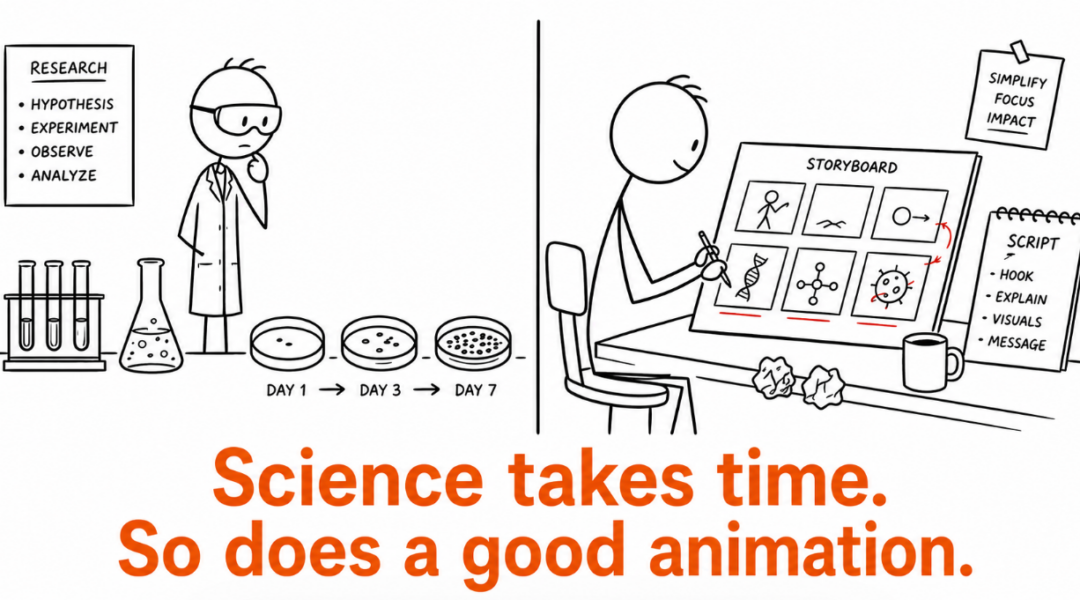
When I explain this to clients, I sometimes use the clinical trial comparison. Not because animation is as complex as drug development — it’s not. But because the underlying principle is the same.
Good work needs iteration. And iteration needs time.
Here’s what actually happens when we make a biotech animation:
We start with a script. It reads perfectly. Clear, logical, complete.
Then we sketch the storyboard. And suddenly something feels off. A transition doesn’t work. The opening buries the key insight. The flow that made sense in words doesn’t make sense visually.
So we go back. Rewrite a sentence. Simplify a visual. Cut something we liked.
Sometimes we’re three rounds in and realize we need to restructure the whole thing. We move sections around. Start again.
This back-and-forth between our team and yours — that’s where the clarity comes from.
What happens when you rush
I’ve seen what rushed biotech animations look like. Not from our studio, but from others.
They’re technically fine. The visuals move. The voiceover plays. But something’s missing.
The story doesn’t land. The investor watches it and thinks “okay, interesting” instead of “now I get it.”
A biotech animation that doesn’t create understanding is a waste of money. Worse — it’s a missed opportunity. You had their attention for two minutes, and you lost them.
Why I said no
I could have said yes to this client. Pulled some late nights. Cut some corners. Delivered something on time.
But I’ve learned that “on time” doesn’t matter if the video doesn’t work.
I lost the order. It still stings.
But I’d rather lose a client than hand over a video that confuses investors.
Your science deserves time. So does the story that explains it.
What’s the thing you refuse to rush?
I’m curious. Whether you’re in biotech, research, or something completely different — what’s the thing you protect from time pressure, even when everyone wants it faster?