I feel the pain of my clients almost daily.
For years, I’ve been telling biotech founders: “People don’t understand your science. You’re not getting the attention you deserve. That must be frustrating.”
Now I feel this frustration myself.
My son is severely ill.
Two world-leading Italian specialists recommended a drug called Dupixent. They believe off-label use could save him.
I thought it would be straightforward to convince a doctor in Poland to prescribe it.
The scientific rationale is strong. My wife Emilia and I spent weeks understanding it. We spoke to multiple specialists. We went deep.
But this isn’t science you can explain in two sentences.
There’s a neuropsychiatric component called PANS/PANDAS. Most doctors either don’t know it — or don’t accept it. Because they’ve never seen a child with it.
But I have.
And I’ve seen how a simple allergy test triggered severe neuropsychiatric symptoms within minutes.
This is real. It’s not a crazy father’s fantasy. And there is a drug that could interrupt that pathway.
But explaining this to Polish doctors, I hit the same walls my biotech clients hit with investors:
- They don’t have time to read the latest science
- They read it, but don’t understand it
- They understand it, but don’t believe it
- They believe it, but won’t take the risk
Some doctors laughed. “Why would a drug for atopic dermatitis help your son?”
Being dismissed when you’re desperate is hard to bear.
This is exactly what many biotech founders feel. They believe in their science. But no one follows.
Why It’s So Hard to Explain Science to Investors
Investors are not scientists. Even those with PhDs often work outside their specialty. They hear dozens of pitches. They have minutes, not hours.
If they don’t understand your science quickly, they doubt it. And doubt kills deals.
The problem isn’t your science. It’s how you explain it.
Words alone often fail. Complex mechanisms, novel pathways, unfamiliar biology — these need more than slides full of text.
What We Did: An Illustration to Explain the Unexplainable
So we did what I always recommend to my clients:
We made a visual.
Not for aesthetics. For understanding. For belief. For action.
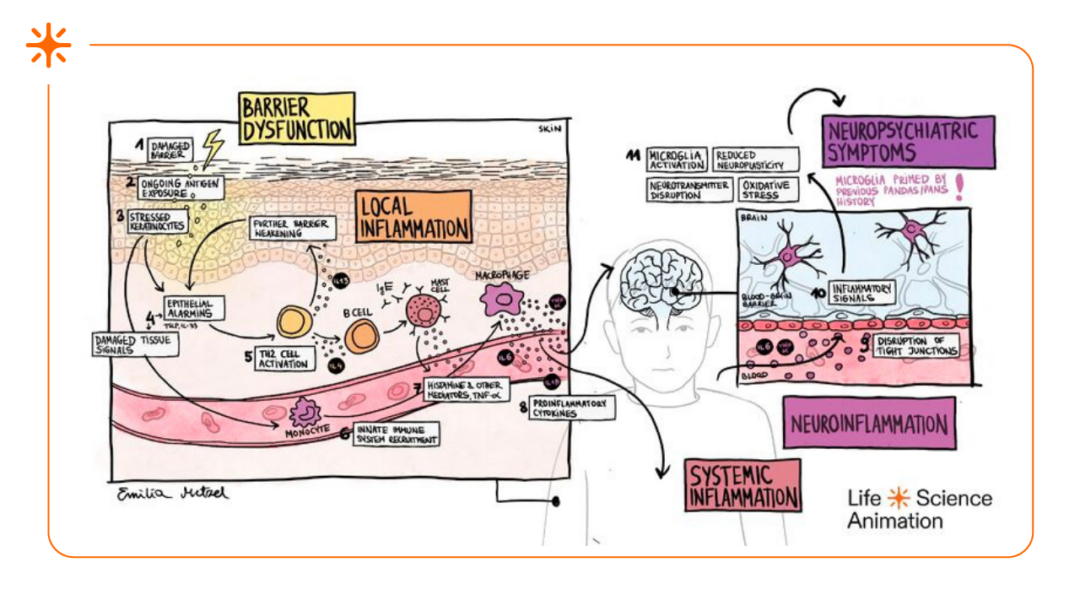
The illustration at the top of this page is our first attempt to explain how skin disease leads to neuropsychiatric symptoms. It’s a working hypothesis — not confirmed science yet. There may be flaws.
But it helps us explain what words alone can’t.
This is exactly what we do for biotech companies. We create illustrations and animations that make complex science accessible — so investors, partners, and doctors can finally understand what you’ve been trying to tell them.
How to Explain Science to Investors: The Key Lessons
If you’re a biotech founder struggling to get investors to believe in your science, here’s what I’ve learned — both from my clients and from my own desperate situation:
1. Accept that words aren’t enough.
If your science is novel, your audience has no mental model for it. You need to build one for them — visually.
2. Simplify without dumbing down.
The goal isn’t to explain everything. It’s to create a “now I get it” moment that opens the door to deeper conversation.
3. Show the mechanism.
Investors want to see how it works. An illustration or animation can do in 60 seconds what a 20-minute explanation can’t.
4. Make it easy to share.
A clear visual travels. It gets forwarded. It sparks conversations you’re not even in the room for.
We Can Help You Explain Your Science to Investors
At Life Science Animation, we create illustrations and animations that help biotech companies communicate complex science to investors, partners, and the public.
Whether you’re raising a seed round or preparing for an investor meeting — if people don’t understand your science, we can help you fix that.